
LIFE ElderCare honors community service awardees

HRC Awardees

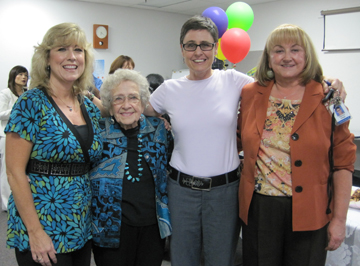
Tammy Duran, MOW Volunteer Coordinator, Mary Margaret Simms, Patricia Osage, Executive Director, Marty Fraga.

LIFE ElderCare is proud to announce that the Fremont Human Relations Commission (HRC) has awarded two of its own: Marty Fraga and Mary Margaret Simms with 2012 Human Services Awards.

At the Fremont City Council meeting on October 2, Mayor Morrison presented the awards for outstanding community service to: Marty Fraga, Mary Margaret Simms, and also to Jeevan Zutshi, Raj Salwan, and Abode Services.

Marty Fraga received the Human Services Professional Award for her long-time leadership at LIFE ElderCare in the Meals on Wheels program. As a nurse and health care educator, Marty brings fourth-year California State University, East Bay nursing students in for a semester at a time to work with the vulnerable seniors who receive our meals. Marty’s deep concern for the needs of older adults has been a life long passion and she is passing that down to the next generation of young health care workers.

“Marty’s program at LIFE ElderCare has enhanced the care provided to our seniors and those with disabilities a hundredfold,” says Barbara Emge, Meals on Wheels Coordinator. “I can’t imagine us being without the vital services they provide.”

Mary Margaret Simms received the Human Services Individual Award for 26 years of service as a LIFE ElderCare Meals on Wheels volunteer driver. Twenty six years! Ms Simms brings a smile to the faces of both staff and meal recipients. She loves what she does and it shows.

“We are very proud of the contributions Marty and Mary bring to LIFE,” said Patricia Osage, Executive Director. “We feel lucky to have so many amazing people as part of the LIFE family. Speaking on behalf of the staff, the other volunteers, and all of our board members and program participants, I can say that we are Marty and Mary’s biggest fans!”

Since the early 1990′s, the HRC has recognized individuals and groups in the community that have made outstanding contributions in the pursuit of equality, justice, human services and human rights for all citizens.


Our Fall Prevention program helps Beatrice, 95, maintain her independence.

For women in their 90′s who want to remain independent and live in their own home, finding the right combination of resources to keep them healthy and mobile can be an ongoing challenge. The biggest concern for many of them is simply getting around the house without falling and staying strong enough to bathe, dress, and cook meals. Having social support and companionship is also very important as advanced age often brings on feelings of isolation and loneliness.

Beatrice, at 95, is lucky to have family in the area who check in on her every day and take her out for trips to the grocery store and Macy’s. She likes shopping and gets a thrill out of choosing just the right gift for one of her children. During the past few years her mobility and strength have been declining but she still gets around her house with a walker and is able to dress herself and warm up meals cooked by her son. She attributes some of her success at remaining independent to LIFE ElderCare’s Fall Prevention program.

Four years ago, Beatrice and her son read about the program and thought it would be a good way for her to get personalized exercise assistance that was pre-approved by her doctor. They also liked the idea of nursing students coming to the home every week to monitor her progress, maintain her motivation and answer questions. Beatrice says about her experience, “Oh yes, I like the program and want to continue with it.” She says the program has helped her stability and she enjoys visiting with the nurses. It is the first exercise program she has ever participated in.

While she is no longer able to shower or bathe on her own, she still takes short walks with her children and accompanies her son to the grocery store every week for shopping. “We are so happy when the program helps older adults stay in the homes they love for as long as safely possible,” says Maureen Parent, Fall Prevention Coordinator, “sometimes for people in their 90′s, just ‘holding the line’ is an amazing achievement.”

The Fall Prevention program is open to anyone age 60 and older who lives in Fremont, Newark and Union City. The supervised exercise program lasts 12 weeks and includes a medication review and home safety check. For more information or to sign up, call Sandy at 510-574-2087.

Meal On Wheels helps Philip, 96, stay independent.

PhilipProfile of Philip, a Fremont resident who has been fixing clocks for 88 years.

In the small Colorado town where I grew up, people brought their broken clocks to the local jewelry store to be repaired. Those that could not be fixed were donated to kids who wanted to play with them. The first one I got couldn’t be fixed because I didn’t have the parts, but a few weeks later I was given another one that was the same model. By taking parts out of that one, I was able to get the other one working. I was eight years old and have been fixing clocks ever since.

I came to California in 1936, but after losing my job went back to Colorado. A high point of that trip was crossing the Bay Bridge from San Francisco to Oakland. It took four hours and cost 65 cents. In 1939, I came back to the Bay Area and got a job as a mechanic for the bus company. I retired in 1980 at 65.

My six children, 20 grandchildren, 20 great-grandchildren and 5 great-greats are spread out all over the country. I only have one son who lives nearby. My wife and I learned about Meals On Wheels about a year ago when I went to the hospital for some tests. I’m 96 and she’s 86, so we were having a hard time keeping up with shopping and cooking. The meals are healthy which helps me manage my diabetes.

Friends Deliver Together

For the past 20 years, Susan and Marilyn have been delivering meals to frail, home bound seniors. We recently chatted with them about how volunteering has enriched their lives.

Susan and Marilyn - Meals On Wheels Drivers

Susan and Marilyn

Susan - I had a friend that used to deliver meals and thought it was something I might like to do, but at the time I still had a daughter who was in the lower grades and had to pick her up early from school. When she started going the full day I thought, I can do this now. I signed up in January 1993.

Marilyn was a neighbor and a good friend and I asked her if she wanted to deliver meals with me. We thought we were going to ease into it but the Coordinator said, “So, can you start tomorrow!” During the first 19 years there were only five times when we could not cover our shift.

It’s more fun to deliver with a friend; we usually have lunch together when we finish. I think the people we deliver to enjoy it too. Some of them see us as “the team” and worry if one of us doesn’t come.

Of course, not everyone wants a connection. Some people just leave their coolers out and we hardly ever see them. But there are other people we become friends with and when they go off the program Marilyn and I continue to visit them. One woman was 98 and almost blind when we started delivering meals to her. We went to her 99th and 100th birthday parties. She outlived all of her five children.

You have more people in your life that are going to leave before you do and that’s hard, but on the other hand, the people we get to know add so much to our lives. The two hours of the week I deliver meals are when I feel most appreciated.

Marilyn - It is nice to deliver together. Some people really look forward to us coming and light up when they see us. It’s an important part of their day and for us as well.

We had one fellow, who at the beginning, definitely did not want us there. He was grumpy and distant but after he got to know us we became really close friends. When he later went into a convalescent home we continued to visit him until he passed away. His wife told us that our visits were the highlight of his week. For some people, the caring connection means more than the meal.

More physicians need to ask their patients about falls.

A recent survey by the Hartford Foundation has revealed that only 19% of older adult patients have had their MD talk with them about fall prevention. This is alarming given the fact that falling is the cause of 90% of all hip fractures and is the leading cause of injury and injury-related deaths in older adults.

We recently interviewed Dr. Dianne Martin, a Fremont, CA-based physician, about what she looks for in assessing whether or not someone is a fall risk. “The patients most likely to take a fall are ones that have balance and mobility problems, decreased muscle strength and are taking medications that affect balance.” She has found that patients who have even minor falls become less confident and lose their feeling of security when walking.

When a patient tells her about having a fall she recommends the Fall Prevention program at LIFE ElderCare. “Having someone who comes to their home really motivates them and gets them excited to participate,” she says.

Dr. Martin would like to see more physicians ask their patients whether or not they have had a recent fall because if the fall is minor, many patients forget to bring it up. If the patients says yes, it gives the physician a great opening to talk about the importance of fall prevention programs. “More and more older adults want to age independently in their own homes,” says Martin. “Whatever we can do to make this a reality is certainly a plus.”

Learn more about LIFE ElderCare’s Fall Prevention program.

View our Fall Prevention Coordinator’s presentation at the 2012 California Wellness Foundation’s Conference on Healthy Aging.

80-year-old community activist signs up for Meals On Wheels

Clara, a long-time community activist, heard her daughter say to her recently,“You volunteer to help others, but you never ask for help yourself.” It got her thinking about how she might utilize the resources available at LIFE ElderCare to help her with some of her daily activities. At age 80, she now has to use a walker to get around and can no longer stand at the stove to make meals.

While her daughter, who she lives with, does grocery shopping, she was finding it hard to get a hot, nutritious mid-day meal. The Meals On Wheels program was the perfect solution. “I have been on the program for a little over a year now and I really enjoy the meals,” she says, “and, as a former registered nurse I know how important good nutrition is to my health.”

When she was younger Clara enjoyed gymnastics and was always physically active. Health problems required to her to take early retirement but she supplemented her income for many years with a small in-home business. After her retirement she moved in with her daughter to help raise her teen-aged grandchildren.

She stays proactive about her health and has three doctors who are concerned and helpful. “I think the community services in the Tri-City area are very good,” she says, “I have access to all kind of services and especially enjoy the caring, Meals On Wheels volunteers who sometimes bring their small children along to visit with me.”

The Lifetime Risk for Osteoporotic Fracture is 50% for Women Over Fifty

At the March 4, Osteoporosis Update at Washington Hospital, I learned a few important things about how to protect my bones. The first presenter, Dr. Barry Shibuya, clarified the difference for me between osteoporosis and joint pain. Osteoporosis is painless, (unless you have a fracture), while osteoarthritis hurts. Also, osteoporosis medication does not relieve joint pain; it only helps protect the body against future bone loss.

Dr. Shibuya alerted the audience to the harmful effect of steroid medication such as Prednisone on bone loss, saying, “If you take 5 mg of Prednisone for three months or longer, you will lose 25% of your bone density within one year.” To protect against osteoporosis he recommended exercise to build bones (bones are like muscles, they become stronger through resistive exercises), increasing your intake of calcium and Vitamin D, ending bad habits such as smoking and enrolling in a Fall Prevention program.

Maureen Parent, Coordinator of LIFE ElderCare’s Fall Prevention program, spoke after Dr. Shibuya and reiterated the importance of exercise in preventing falls. She pointed out that falls are the number one reason why seniors lose their independence. After a fall, the fear of falling again restricts a person’s willingness to engage in normal activities. And, the more sedentary and homebound they become, the more likely they are to fall again. People who have completed the 12-week, in-home, Fall Prevention class have reported a significant decrease (up to 70%) in their fear of falling again.

The major risk factors for falls are balance impairments, weak muscles, impaired vision, medications, and home environmental hazards such as inadequate lighting, clutter, throw rugs, as well as the incorrect use of assisted devices such as canes and walkers. The Fall Prevention program at LIFE ElderCare addresses all of the risk factors through a personalized exercise program, assistance with medication management and assistance with reducing hazards in the home. Enrollment is continuous so if you are age 60 and older, and are predominately homebound, this is a great way to keep you free from falls.

Rachael Vander Martin, Communications Specialist

See links for more information:

LIFE ElderCare Fall Prevention
Assess your Future Fracture Risk
Dr. Barry Shibuya

Fun-Raiser at Sweet Tomatoes, March 9, 2011 from 5-8 pm.

Please join members of the staff and Board of LIFE ElderCare at Sweet Tomatoes restaurant for our Fun-Raiser. This is our first partnership with a local restaurant to raise money and we need your participation to make it a success. 15% of the cost of your meal will be donated to LIFE ElderCare. Invite friends, family, friends-of-friends—everyone you know who likes to eat fresh, wholesome food.

*** NOTE: (You must present the Sweet Tomatoes Donation Form when you pay for your meal. Be sure to download this form and bring it with you).

Sweet Tomatoes is located at: 39370 Paseo Padre Pkwy (corner of Paseo Padre and Walnut Avenue) in Fremont. For directions to the restaurant visit: sweettomatoes.com

An increasing number the “near-elderly” (55-64) in the Tri-City area need our help.

At 58, Susan has no permanent home, no car, and no valuables other than her loving cat. She lives in a nearby motel where the manager gives her a good rate. She has been getting meals from Meals On Wheels since March 2009 and started using VIP Rides in April of last year.

In November of 2009 she had a stroke that has made her unsteady on her feet and has brought on chronic back pain. Social Security is threatening to cut off her medical benefits if she does not meet their criteria for the medically disabled.

Susan uses VIP Rides on a regular basis to get to the Fremont Food Bank, her doctor visits, and to do necessary errands. After she received notice that her medical coverage might be terminated, she called us to get a ride to her local clinic. Fortunately, a volunteer was available to help her on short notice. They both went to the clinic and the desk attendant told Susan not to fear anything yet, and made an appointment with her doctor for the following day. This brought much relief. After returning home, Susan offered the volunteer a glass of water and thanked her for being so kind. “Without VIP Rides” she said, “I would be stranded.”

Lori Vogel, VIP Rides Coordinator

Forgetting to turn off the stove can make some seniors averse to cooking.

Last month I did an assessment on a man, close to 90 years old, who came to the US from Ireland. He says he really likes Meals On Wheels because the food is nutritious, and if he’s not hungry when the meal comes, it is easy to heat it up in the microwave later. He tries to make Irish stew at least twice a month but finds that once he walks away from the stove he forgets about it. ”I can’t tell you how many times I make stew and burn it,” he says. ”I use to be a good cook, but not anymore.”

His daughters have warned him about the dangers of both cooking and driving, at age 90, but he pays no attention to them and drives to see his wife who is in a nursing home in Hayward. He has a great need to see her everyday. He left his wife in Ireland with 4 kids to come to California to get a job. She had to raise the kids alone for years before he had enough money to bring everyone over.

Notes from the Field
Barb Proctor, Meals On Wheels Assessment Coordinator